Monday, October 29

A black cat, a shovel, a shallow plot, Bloody Sunday.


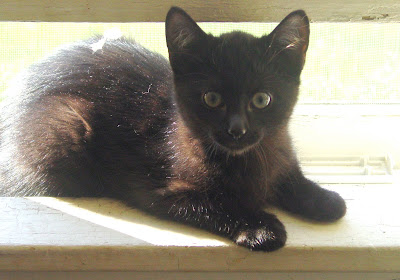
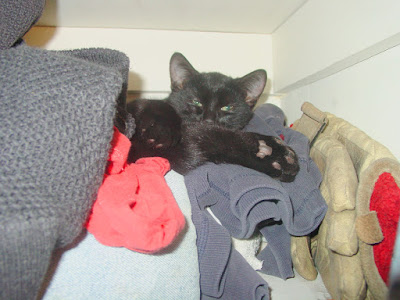
Aimer's new cat, Teddie Bear, scared the hello out of me Sunday morning. I went to get something out of the closet and saw eyes looking back at me. It was really dark in that corner, so dark I had to use a flash to take this picture.


The shelf is at eye level. I'm amazed Teddie was able to get up there without pulling all my stuff down. It sure doesn't stop him around the rest of the house. I'm constantly picking up something he has knocked to the floor and then started playing with. Usually it is pens or papers but he has also dumped a couple of our things off the coffee table (remotes for the digital receiver, regular TV, DVD, stereo receiver,VCR, and the cordless phone Amy never put in the charger - which unsurprisingly is usually dead).


By the way, looking at the picture, I can see where I put my gloves away last spring. I've been wondering where they went. Good, I thought I had lost them.
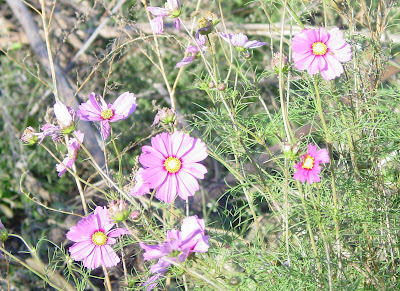


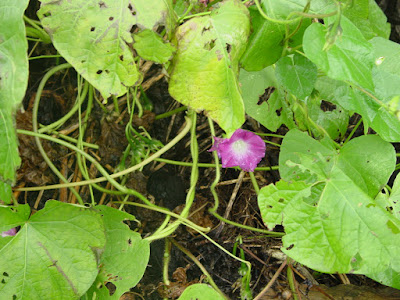
We got our first real frost Saturday night. It killed off almost all my flowers. The ones above survived because they were next to a fence of cucumber vines that must have blocked the chill. Most of my plants in containers survived too because they were close to the house.


I spent the afternoon digging up dahlia bulbs. I have them in the garden, behind the garage, and outside the house. After they die from frost, you need to dig them up (they are in clumps). I hauled them down to the basement where they can dry out and then be stored till spring. It took me most of the afternoon but in I at least feel that I accomplished something. An alternative would have been watching the Chicago Bears play Detroit. (I can't believe the Bears were in last year's Superbowl. And I can't believe in 8 games I've only picked them right 3 times.)


While I do all my chores outside, Cubbie just follows me around, hardly ever getting under my feet. We have a lot of dogs in the neighborhood so he is constantly marking spots or sniffing those spots marked by other dogs.


U2, Bloody Sunday. I just happen to like this song and it fit with this post's title.

Tuesday, October 23

The Trail of History.


Trail of History.


Sunday afternoon I went to the Trail of History. The McHenry County Conservation District (MCCD) holds this every third weekend in October. It is held in one of our nicer conservation areas, with large kames giving it a border to the east and a stream to the west.

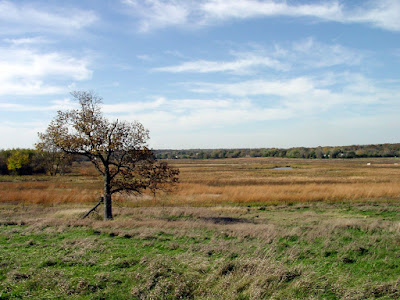
From the parking lot, you must follow a path about one mile thru prairie grasses to get there. I came by myself (meeting Clint and Jen later) so I was able to take my time and snap some pictures.


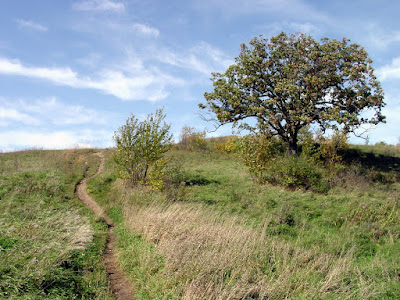
Walking up and over a kame, you see a field that is full of tents. That is a kame below though the narrow path running up it was off limits for the day. We came in on a much wider path.

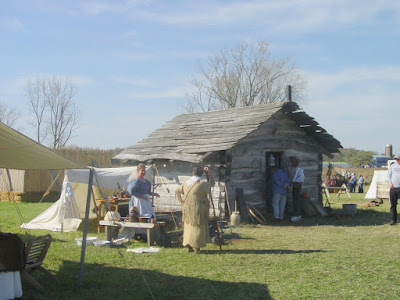
Each campsite is like a different snapshot of the past.


Living history interpreters from across the country portray different things that would have occurred in 18th and 19th century America. There were hunters, blacksmiths, candle makers, canoe makers, doctors, innkeepers, etc.


The main stage had dancers (square dance of course). Another area had jugglers and a couple of times a day battle re-enactments were held in a bordering field.


The conservation area is located less than 15 miles away from home. I have to admit I’ve only been to it a couple times. I used to drive twice as far to go to another one I was more familiar with. Not anymore. I really liked this place.

On non-event days there are miles of paths you can follow. Hills, trees, prairie areas, ponds and a stream make you feel close to nature. Our county is one of the fastest growing in Illinois so it’s nice to have places like this set aside, off the beaten path.

Slide show:


Tuesday, October 16

Fall and deadfall.


Watch out for the truck Gage. Oh well, fate is fate. If he was George of the Jungle it would have been a tree.


Poor Gage. Poor Winston Churchill.


Not related but by the way, Aimers came home with a little black kitten last week. Said she was watching it for a friend (Amanda) who was going to be out of town for a week.


That fabrication fell apart when my brother in law saw Amanda at work a day later. We have a new kitten.


I have to admit he is cute though dangerous. He has almost tripped me twice running between my feet while I'm walking in the house. I wish I had that energy.


Keeping with Amy's local sports team nomenclature (Cubs and Chicago Bears), he is named Teddy Bear to go along with her dog, Cubbie Bear. And ironically, the Bears are in a stretch where they are playing like Teddy Bears.


It had pretty much quit drizzling Sunday afternoon so Cubbie and I went out to the backyard to take some pictures.


Our backyard borders a field that will eventually be developed. (One good thing about the slow housing market.) The land is sold, but until houses are built, farmers lease the empty land. They rotate corn and soybeans each year. This year it was soybeans.


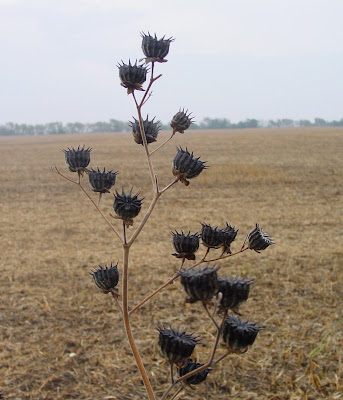
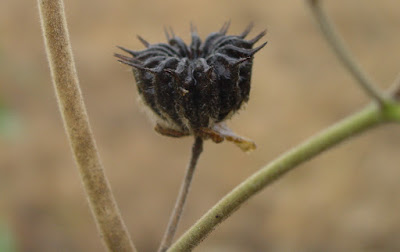
I took a bunch of pictures of this plant. I grew up on a farm and should probably know what it is but I don't. Help. I'm betting it is something really common and I'll feel stupid. Until I started taking pictures of them, I didn't even notice the pretty little things. They remind me of crowns or wrapped candy.


At the end of the garden I have a large burn pile. We throw all yard waste on it and usually burn it in the spring and in the fall. This summer, morning glories grew wild on it almost covering it. I am holding off burning till it freezes and kills the flowers.


With the pieces of wood and branches, along with the growth, the burn pile reminds me of the deadfall from the movie Pet Sematary. Mine is only as wide as a burn pile would be, but I could imagine it being over twenty some feet wide as in the book.


To me, that was one of the scariest parts of the book. Below, I've included text that mentioned and described the deadfall as found in google.


Excerpts and notes:


Louis experiences what he believes is a very vivid dream in which he meets Pascow, who leads him to the "sematary" and refers specifically to the "deadfall," a dangerous pile of tree limbs that form a barrier at the back of the cemetery and warns Louis to not "go beyond, no matter how much you feel you need to."


Louis wakes up in bed the next morning convinced it was only a dream, until he discovers his feet and the bedsheets covered with dirt and pine needles. Louis still dismisses the dream as the product of the stress he experienced during Pascow's death, coupled with his wife's lingering anxieties about the subject of death


-----------------
Its a this point that Louis notices the deadfall on the far end of the Pet Sematary which separated these woods from the Indian woods. It occurred to Louis that this deadfall seemed too "convenient, too artful, to perfect, for the work of nature."


----------------------
deadfall - a tangle of weather whitened old branches at the back of the clearing. It's maybe twenty-five feet from side to side and about nine feet high. At either end are thick knots of underbrush that look impassable.

Thursday, October 11

Doris Lessing, The Fifth Child.


Doris Lessing wins Nobel Prize in literature
The Associated Press
Wednesday, October 10, 2007
STOCKHOLM, Sweden: Doris Lessing, author of dozens of works from short stories to science fiction, including the classic "The Golden Notebook," won the Nobel Prize for literature Thursday. She was praised by the judges for her "skepticism, fire and visionary power."
-------------

I read "The Fifth Child" this spring while waiting for the last Harry Potter to come out. I didn't know anything about it when I started reading it but quickly found it to be quite different and interesting. It is only about 130 pages but is full of very realistic characters and emotions.

I'm glad I read it. I will be checking out some of her other ones, probably some of her science fiction. This reminded me a little of Robert A. Heinlein's "Stranger in a Strange Land". In both, there was always a large communal gathering of friends and family around holidays with people staying for days.

By the way, I got the book at our local recycling center's book sale. $ 1.00 for a hard cover first edition. Yea.

--------------

From the book jacket:


Harriet and David Lovatt want the same things - fidelity, love, family life and above all a permanent home. Stubbornly out of line with the fashions of the 1960s they decide to marry and lay down the foundations of their haven in a rambling Victorian house.
At first, all is idyllic. Children fill their lives and re-united relatives crowd round the kitchen table at Christmas and Easter, greedily enjoying the warmth and solidity of the Lovatts home. It is with the fifth pregnancy that things begin to sour. The baby moves inside Harriet too early, too violently. After a difficult birth, he develops faster and grows much bigger than ordinary infants; he is unloving and instinctively disliked by his brothers and sisters. Inexorably, his alien presence wrecks the dream of their happy family. Harriets fear grows as she struggles to love and care for the child, finding herself faced with a dark sub-continent of human nature, unable to cope.

With The Fifth Child Doris Lessing triumphs in a realm of fiction new to her. She has written an ominously tangible novel, a powerfully simple contemporary horror story that makes compulsive reading to the last word.


Comments:
Received the Grinzane Cavour Prize in Italy

Nominated for the 1988 Los Angeles Times Book Award

Tuesday, September 25

Into the Wild, paper and digital.


Into the Wild by Jon Krakauer is a true story of “a young man from a well-to-do family who hitchhiked to Alaska and walked alone into the wilderness north of Mt. McKinley. His name was Christopher Johnson McCandless. He had given $25,000 in savings to charity, abandoned his car and most of his possessions, burned all the cash in his wallet, and invented a new life for himself. Four months later, his decomposed body was found by a moose hunter."

I read this book last spring. Usually I read fiction. And if I am going to read a non-fiction book, I wouldn't normally pick one that ends in tragedy. A friend lent it to me - she thought I would like it. I had read Jon Krakauer's Into Thin Air about climbing Mt. Everest and liked his narrative style.

I put aside whatever John Sandford or Harry Potter (I'm predictable) I was reading at the time to read it. It's not a really long book but it gives a really good picture of Christopher's character. He uses the name Alexander Supertramp during his travels which I thought interesting - dropping out of society to live in the wilderness but maintaing a link to rock and roll.

What impressed me the most about the story was how much people he met liked him and wanted to help him.

The book includes stories from people who knew or met Christopher during his journey. Sean Penn made it into a movie that was just released with Emile Hirsch playing Christopher. I never heard of him and think that should actually help the movie - I think he should be unknown to us as we learn about him.

Here is an excerpt from the book Into the Wild:


THE ALASKA INTERIOR
April 27th, 1992


Greetings from Fairbanks! This is the last you shall hear from me, Wayne. Arrived here 2 days ago. It was very difficult to catch rides in the Yukon Territory. But I finally got here.

Please return all mail I receive to the sender. It might be a very long time before I return South. If this adventure proves fatal and you don't ever hear from me again I want you to know you're a great man. I now walk into the wild. --Alex.


(Postcard received by Wayne Westerberg in Carthage, South Dakota.)

Jim Gallien had driven four miles out of Fairbanks when he spotted the hitchhiker standing in the snow beside the road, thumb raised high, shivering in the gray Alaska dawn. He didn't appear to be very old: eighteen, maybe nineteen at most. A rifle protruded from the young man's backpack, but he looked friendly enough; a hitchhiker with a Remington semiautomatic isn't the sort of thing that gives motorists pause in the forty-ninth state. Gallien steered his truck onto the shoulder and told the kid to climb in.

The hitchhiker swung his pack into the bed of the Ford and introduced himself as Alex. "Alex?" Gallien responded, fishing for a last name.

"Just Alex," the young man replied, pointedly rejecting the bait. Five feet seven or eight with a wiry build, he claimed to be twenty-four years old and said he was from South Dakota. He explained that he wanted a ride as far as the edge of Denali National Park, where he intended to walk deep into the bush and "live off the land for a few months."

Gallien, a union electrician, was on his way to Anchorage, 240 miles beyond Denali on the George Parks Highway; he told Alex he'd drop him off wherever he wanted. Alex's backpack looked as though it weighed only twenty-five or thirty pounds, which struck Gallien--an accomplished hunter and woodsman--as an improbably light load for a stay of several months in the backcountry, especially so early in the spring. "He wasn't carrying anywhere near as much food and gear as you'd expect a guy to be carrying for that kind of trip," Gallien recalls.

The sun came up. As they rolled down from the forested ridges above the Tanana River, Alex gazed across the expanse of windswept muskeg stretching to the south. Gallien wondered whether he'd picked up one of those crackpots from the lower forty-eight who come north to live out ill-considered Jack London fantasies. Alaska has long been a magnet for dreamers and misfits, people who think the unsullied enormity of the Last Frontier will patch all the holes in their lives. The bush is an unforgiving place, however, that cares nothing for hope or longing.

"People from Outside," reports Gallien in a slow, sonorous drawl, "they'll pick up a copy of Alaska magazine, thumb through it, get to thinkin' 'Hey, I'm goin' to get on up there, live off the land, go claim me a piece of the good life.' But when they get here and actually head out into the bush--well, it isn't like the magazines make it out to be. The rivers are big and fast. The mosquitoes eat you alive. Most places, there aren't a lot of animals to hunt. Livin' in the bush isn't no picnic."

It was a two-hour drive from Fairbanks to the edge of Denali Park. The more they talked, the less Alex struck Gallien as a nutcase. He was congenial and seemed well educated. He peppered Gallien with thoughtful questions about the kind of small game that live in the country, the kinds of berries he could eat--"that kind of thing."

Still, Gallien was concerned. Alex admitted that the only food in his pack was a ten-pound bag of rice. His gear seemed exceedingly minimal for the harsh conditions of the interior, which in April still lay buried under the winter snowpack. Alex's cheap leather hiking boots were neither waterproof nor well insulated. His rifle was only .22 caliber, a bore too small to rely on if he expected to kill large animals like moose and caribou, which he would have to eat if he hoped to remain very long in the country. He had no ax, no bug dope, no snowshoes, no compass. The only navigational aid in his possession was a tattered state road map he'd scrounged at a gas station.

A hundred miles out of Fairbanks the highway begins to climb into the foothills of the Alaska Range. As the truck lurched over a bridge across the Nenana River, Alex looked down at the swift current and remarked that he was afraid of the water. "A year ago down in Mexico," he told Gallien, "I was out on the ocean in a canoe, and I almost drowned when a storm came up."

A little later Alex pulled out his crude map and pointed to a dashed red line that intersected the road near the coal-mining town of Healy. It represented a route called the Stampede Trail. Seldom traveled, it isn't even marked on most road maps of Alaska. On Alex's map, nevertheless, the broken line meandered west from the Parks Highway for forty miles or so before petering out in the middle of trackless wilderness north of Mt. McKinley. This, Alex announced to Gallien, was where he intended to go.

Gallien thought the hitchhiker's scheme was foolhardy and tried repeatedly to dissuade him: "I said the hunting wasn't easy where he was going, that he could go for days without killing any game. When that didn't work, I tried to scare him with bear stories. I told him that a twenty-two probably wouldn't do anything to a grizzly except make him mad. Alex didn't seem too worried. 'I'll climb a tree' is all he said. So I explained that trees don't grow real big in that part of the state, that a bear could knock down one of them skinny little black spruce without even trying. But he wouldn't give an inch. He had an answer for everything I threw at him."

Gallien offered to drive Alex all the way to Anchorage, buy him some decent gear, and then drive him back to wherever he wanted to go.

"No, thanks anyway,"Alex replied, "I'll be fine with what I've got."

Gallien asked whether he had a hunting license.

"Hell, no," Alex scoffed. "How I feed myself is none of the government's business. Fuck their stupid rules."

When Gallien asked whether his parents or a friend knew what he was up to--whether there was anyone who would sound the alarm if he got into trouble and was overdue Alex answered calmly that no, nobody knew of his plans, that in fact he hadn't spoken to his family in nearly two years. "I'm absolutely positive," he assured Gallien, "I won't run into anything I can't deal with on my own."

"There was just no talking the guy out of it," Gallien remembers. "He was determined. Real gung ho. The word that comes to mind is excited. He couldn't wait to head out there and get started."

Three hours out of Fairbanks, Gallien turned off the highway and steered his beat-up 4 x 4 down a snow-packed side road. For the first few miles the Stampede Trail was well graded and led past cabins scattered among weedy stands of spruce and aspen. Beyond the last of the log shacks, however, the road rapidly deteriorated. Washed out and overgrown with alders, it turned into a rough, unmaintained track.

In summer the road here would have been sketchy but passable; now it was made unnavigable by a foot and a half of mushy spring snow. Ten miles from the highway, worried that he'd get stuck if he drove farther, Gallien stopped his rig on the crest of a low rise. The icy summits of the highest mountain range in North America gleamed on the southwestern horizon.

Alex insisted on giving Gallien his watch, his comb, and what he said was all his money: eighty-five cents in loose change. "I don't want your money," Gallien protested, "and I already have a watch."

"If you don't take it, I'm going to throw it away," Alex cheerfully retorted. "I don't want to know what time it is. I don't want to know what day it is or where I am. None of that matters."

Before Alex left the pickup, Gallien reached behind the seat, pulled out an old pair of rubber work boots, and persuaded the boy to take them. "They were too big for him," Gallien recalls. "But I said, 'Wear two pair of socks, and your feet ought to stay halfway warm and dry.'"

"How much do I owe you?"

"Don't worry about it," Gallien answered. Then he gave the kid a slip of paper with his phone number on it, which Alex carefully tucked into a nylon wallet.

"If you make it out alive, give me a call, and I'll tell you how to get the boots back to me."

Gallien's wife had packed him two grilled-cheese-and-tuna sandwiches and a bag of corn chips for lunch; he persuaded the young hitchhiker to accept the food as well. Alex pulled a camera from his backpack and asked Gallien to snap a picture of him shouldering his rifle at the trailhead. Then, smiling broadly, he disappeared down the snow-covered track. The date was Tuesday, April 28, 1992.

Gallien turned the truck around, made his way back to the Parks Highway, and continued toward Anchorage. A few miles down the road he came to the small community of Healy, where the Alaska State Troopers maintain a post. Gallien briefly considered stopping and telling the authorities about Alex, then thought better of it. "I figured he'd be OK," he explains. "I thought he'd probably get hungry pretty quick and just walk out to the highway. That's what any normal person would do."

And the movie trailer, Into the Wild:

Friday, September 21

Nailed it. (riveting news?)

The Northwest Herald: link to actual article here. This is our local paper (and local stupidity it seems too). I sent the article to the Obscure Store and reading room , who are usually are laden with Wisconsin oddities (our neighboring state - had to get a comment in). Ha.

I love reading the paper every night after work. Make a drink, turn on radio in the garage, and take a seat on the picnic table. Read.

We've had some entertaining news lately; a FORMER FISHING GUIDE TURNED
vegan teacher trying to change the middle school menu (before he was suspended), a mother complaining it was too hot in the classroom for her son "Michael" and wanted air conditioning installed in every classroom in the school (which would budget out at about 7 million dollars) - which prompted other letters stating the fact that we have on average, only about 10 days a year where it is really uncomfortable in the heat. And that Michael was probably a "momma's boy". And she is an "IDIOT". Ha.

The most unbelievable was the story below. Nails in mulch installed around the playground at a day care center:
(everything below is copied from the paper)


A sampling of the thousands of nails and other things found in the mulch laid in the playground of the Woodstock Early Learning center. (Kristy Ann Mann photo)
Day care center, mill sharply divided over nail-filled mulch


By JENN WIANT -
jwiant@nwherald.com

Comments (No comments posted.)

WOODSTOCK – When Melissa Norman learned that maintenance workers had found thousands of nails in the playground mulch at the Woodstock Early Learning Center, she was skeptical.

Norman, the assistant director of the child care center near Routes 47 and 120 in Woodstock, also has a 3-year-old daughter who goes to the center and plays on the playground twice a day.

“To knowingly provide this to a child care center, I just couldn’t believe it,” she said.

The mulch came from G & C Mill, a 10-year-old lumber and mulch company on Route 14 between Woodstock and Harvard.

Owner Cindy Ojeda said she had recommended a cheaper natural mulch that was not made from reprocessed wood, but the maintenance director for Woodstock Christian Life Services, which includes the Early Learning Center, chose a cedar mulch made from recycled wood that Ojeda said could include nails that would not be caught by a magnet.

“I would never have put that cedar mulch [on the playground],” Ojeda said. “But this is my customer. Who am I to tell a customer no? If you choose this product, I’m not going to say, ‘Don’t buy my mulch.’ ”

LeeAnn Atwood, spokeswoman for Woodstock Christian Life Services, said Director of Maintenance Rick Madsen had specifically asked for a mulch without nails and had not been told that the cedar mulch could contain nails. He chose cedar because it would help to keep bugs away, she said.

The Early Learning Center ordered 40 yards of cedar mulch and kept adding 20 yards at a time until it was up to 120 yards. Ojeda asked why the center did not complain until four days after the project was complete.

Atwood said the mulch originally was spread by a machine, so maintenance workers did not notice the nails right away. When a maintenance worker showed Madsen a handful of what appeared to be aluminum nails Sept. 5, he found it unusual but did not yet think it was a problem, Atwood said.

As more truckloads were dropped off during the next two days, workers collected nearly 3,000 nails, Atwood said. Madsen called Ojeda to complain the following Monday, Sept. 10.

“She was really unwilling to cooperate and help us in any way,” Atwood said.

Ojeda said it was too late to take the mulch back or give a refund: She already had spent more than $1,000 to have the mulch processed and delivered, and was out about $3,000 worth of product.

A local group that did not want its name released has offered to provide free mulch for the playground, which should open again in about a week, Atwood said. For now, a six-foot-tall pile of woodchips and nails sits in the Early Learning Center parking lot. Jim Tomasello of Tomasello’s Landscaping in Cary has offered to remove the pile for a reduced cost, but he is having trouble finding a place to take it.

“Nobody wants it,” Tomasello said. “We’ve tried giving it away, but nobody will take it because of the nails in it.”

Mulch made from reprocessed wood rarely is used unless is it colored because the dry wood holds color well, said Tomasello, whose company sells mulch. But even for recycled mulch, the number of nails that the Early Learning Center workers found seemed excessive, he said.

“I was very shocked that [G & C Mill] sold them something that was construction debris and had nails in it, and they dumped it right on the playground, knowing that kids were going to be playing in this,” Tomasello said.

Maintenance workers also found rusty hinges, rocks, pieces of aluminum cans, and chunks of plastic.

No one was hurt by the nails and other debris because the playground, which is used by about 140 children ages 4 to 12, had been closed while the mulch was being replaced, Atwood said.

Stacey Dougherty, who takes her three young children to the Early Learning Center each morning, said she was shocked to learn about the nails in the mulch on Wednesdaysept. 19.

“I was very surprised that a company would risk the safety of especially children, but people in general, for the profitability of their company,” Dougherty said.

Thursday, September 20

Intertwined movies.

Anthony LaPaglia is best known as FBI agent Jack Malone in the TV series Without a Trace (season 6 premiere coming up in a week).

Here he plays a cop in the movie Lantana made in his native country, Australia.

The name Lantana derives from the plant Lantana, a weed prevalent in suburban Sydney. It is a metaphor for the tangled, intertwined relationships that are present in the film. (wiki)

Ebert says this movie reminds him of Short Cuts or Magnolia. I agree on the Short Cuts and would like to add 11:14 as another movie it brings to mind. Plus I liked 11:14 and always like a chance to post a trailer of a good movie. (It gets 100% on the Tomatometer!!!) I may review it later - I'm just posting the trailer for now. Watch it - it's good.

Latana trailer:


11:14 trailer:

Lantana

Release Date: 2002
Ebert Rating: ***½
By Roger Ebert Jan 18, 2002

"Lantana" opens with a camera tracking through dense Australian shrubbery to discover the limbs of a dead woman. We are reminded of the opening of "Blue Velvet," which pushed into lawn grass to suggest dark places hidden just out of view. Much of the movie will concern the identity of the dead woman, and how she died, but when the mystery is solved, it turns out to be less an answer than a catalyst--the event that caused several lives to interlock.

Ray Lawrence's film is like Robert Altman's "Short Cuts" or Paul Thomas Anderson's "Magnolia" in the way it shows the lives of strangers joined by unsuspected connections. It discovers a web of emotional hope and betrayal. At its center is a cop named Leon Zat (Anthony LaPaglia) in the process of meltdown; he is cheating on his wife, he has chest pains, he beats a suspect beyond any need or reason, he is ferocious with his son, he collides with a man while jogging and explodes in anger.

Leon's wife Sonja (Kerry Armstrong), worried about him, is seeing a psychiatrist named Valerie Somers (Barbara Hershey). Valerie is married to John Knox (Geof-frey Rush). A few years ago their daughter was killed. Valerie wrote a book as a way of dealing with the experience. John hides behind a stolid front. One of her clients (Peter Phelps) is a gay man who wants to talk about his married lover, and Valerie comes to suspect that the lover is, in fact, her own husband.

Other characters. Jane (Rachael Blake) is the separated housewife who is cheating with Leon. Her neighbors are the happily married Nik and Paula D'Amato (Vince Colosimo and Daniela Farinacci). When Valerie's car is found abandoned and she is missing, murder is feared, and Leon is assigned to the case. He suspects her husband John, and there is another suspect--Nik, the father of three, seen throwing a woman's shoe into the underbrush by Jane. When Leon arrives to question Jane, it is significant, of course, that they were lovers.

This description no doubt makes the film seem like some kind of gimmicky puzzle. What's surprising is how easy it is to follow the plot, and how the coincidences don't get in the way. Lawrence's film, based on a play by Andrew Bovell, only seems to be a murder mystery. As it plays out, we're drawn into the everyday lives of these characters--their worries, their sorrows, the way they're locked into solitary sadness. Nik and Paula are the only happy couple, blessed with kids, happiness, and uncomplicated lives. When the evidence seems overwhelming against Nik, we can hardly believe it. Certainly Valerie's husband, or even an ominous dance instructor, might make better suspects.

LaPaglia makes his cop into a focus of pain: He cheats, takes no joy in cheating, is violent, takes no joy in violence, is shut inside himself. LaPaglia is so identified with American roles that "Lantana" comes as a little surprise, reminding us that he has an Australian background. The other actors, especially Hershey, Rush and the two unhappy women in the cop's life (played by Armstrong and Blake) are so attentive to the nuances of their characters, so tender with their hurts, that maybe we shouldn't be surprised when the crime plot turns out to be a form of misdirection.

One particularly effective scene involves a conversation between LaPaglia and Rush. It comes at a point when LaPaglia clearly thinks the other man has murdered his wife, and the Rush character almost willfully says things that will not help his case. In another kind of movie, his dialogue could be cheating--deliberately misleading the audience. Here we sense it grows out of a disgust he feels, that he is not a better man.

Lawrence and Bovell ground their stories in a lot of domestic details involving children: the daughter Valerie and John lost; the sons Leon has alienated himself from; the D'Amato kids, who need baby-sitting and get earaches. After Jane reports her suspicions about the neighbors, she ends up minding the kids, and there is a wonderfully observed moment when the little one gets sick and the slightly older one knows just what medication is necessary.

Lantana is, we learn, the name of a tropical shrub that, transplanted to Sydney, prospered and became a nuisance. What is its connection to the film? Perhaps suspicion can also grow out of control, when people get out of the habit of assuming that others are good and mean well.

Cast & Credits

Leon: Anthony Lapaglia
John: Geoffrey Rush
Valerie: Barbara Hershey
Sonja: Kerry Armstrong
Jane: Rachael Blake
Nik: Vince Colosimo

Lions Gate Entertainment Presents A Film Directed By Ray Lawrence. Written By Andrew Bovell, Based On His Play &Quot;Speaking In Tongues.&Quot; Running Time: 121 Minutes. Rated PG-13 (For Language And Sexuality).

Wind and rail.


Sunday my brother and sister in law had a birthday party for their daughter, Seneca.

It was a nice late summer / fall-like day to mingle outside and watch bit and pieces of football games on the garage TV. Terrible reception but the Bears managed to win, making it worthwhile.

He is an avid Saturday auction follower. Many strange things follow him home. The railroad crossing above is mixed in with Seneca's playset, jungle gym, trampoline, rope swing, and other assorted toys. (Did I mention it is his first kid?)

Always something interesting. The windmill is in my brother's backyard. It's probably 25 feet high. I cranked up the shutter speed to stop the motion - it was windy out. He also has a real farm windmill he bought for parts. That is in much worse shape. We don't even get surprised at what he buys anymore. Ha.


Friday, September 14

Eastern Promises.

This looks good to me. Roger Ebert gives it 4 stars.

I've liked most of Cronenberg's movies. I think Scanners or Videodrome (with Blondie and a much younger looking James Woods) was one of the first of his I've seen. They were both memorable. I also enjoyed his next couple, The Dead Zone (Stephen King) and The Fly.


I recall Jeff Goldblum and Geena Davis were an item around that time. One other thing I remember about that movie was when Goldblum's character notices a "hair" growing out of his body (I don't remember where) and he couldn't cut it - it was a "fly" hair and really strong and wirey. Ewww.


I also really liked Cronenberg's dark, moody, sexy, and violent Crash with James Spader and Holly Hunter. In fact, I may do something on Spader in the future. He has done quite a wide variety of characters - almost always coming across smart and / or cocky, or at the least self assured. He reminds me of me (I wish).


David Cronenberg reunites with Viggo Mortensen, star of their "A History of Violence" (2005) "Nothing much happens here" (from the trailer) could be the motto of most towns I've lived in..

History was an entertaining, violent movie. Not the best, slightly predictable, but I liked it anyway. I'm looking forward to Eastern Promises.

Eastern Promises trailer:


A History of Violence trailer:


Videodrome (with Blondie(Debbie Harry) and James Woods) trailer:


Tuesday, September 11

Dahlia show.

Dahlia festival, St Charles, Illinois


Sunday was beautiful. It was opening day for the NFL but the Bears weren't scheduled to play until 3:00PM. In hindsight, it wasn't much of a game to watch anyway.

St. Charles Illinois is a pretty city on the Fox River about 40 miles south of us. They were having their 41st (I had never heard of - where have I been? Ha.) dahlia flower show at a local resort.

I've been growing the simple, smaller, round, red dahlias for years. They flower all summer but I have to dig them up before it freezes and store them in the basement. It is worth the effort though.

Clint and Jenni had seen notice of the show so we all decided to take a drive down there. Had fun. They also treated me to lunch. Perfect day.


Football update: I was cruising at 10 and 4 Sunday, surviving some close games.

Monday killed me. First Baltimore couldn't score in the red zone, losing to Cincy. The (quite) later game had San Fran beating my pick, Arizona, in the last seconds. A possible 12 and 4 ended up a pedestrian 10 and 6. I hate football pools!!!